
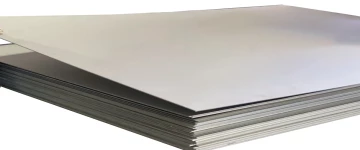

AMS 4911 is the most widely used standard for Ti-6Al-4V (TC4 / Gr5) Titanium Alloy sheet metal in the aerospace field. It represents more than just "material qualification"; it signifies a stringent aerospace quality assurance system (melting, flaw detection, and microstructure control).
| Dimension | STM B265 (Gr5) | AMS 4911 | |||||||||
| Standard nature | General industrial standards (chemical, medical, general aviation) | Aerospace-specific materials specifications | |||||||||
| Mechanical properties | Tensile strength ≥ 895 MPa, yield strength ≥ 828 MPa, elongation ≥ 10% | Tensile strength ≥ 895-930 MPa, yield strength ≥ 825-860 MPa, elongation ≥ 6-10% | |||||||||
| Smelting process | Typically, it involves 1-2 vacuum melting processes (as long as the performance requirements are met). | Forced double vacuum melting (VAR x3) results in a denser microstructure. | |||||||||
| Testing requirements | Standard chemical composition, stretching, dimensions | Add ultrasonic flaw detection (UT), bending test, low magnification tissue and surface contamination inspection | |||||||||
| Hydrogen content control | ≤ 0.015% | Typically, the requirements are stricter (≤ 0.0125%), with higher standards for preventing hydrogen embrittlement. | |||||||||
| Manufacturer: Shaanxi Zhuohangxin Metal Materials Co., Ltd. sales@ti-metals.com | |||||||||||
Why are they said to have "same performance but different grades"?
1. Basic Properties: Highly Overlapping Data
If you only look at the tensile data on the material certificate, the two are almost indistinguishable. Taking the annealed state as an example:
Strength: The lower limit of the tensile strength (Rm) for both is around 895 MPa, and the lower limit of the yield strength (Rp0.2) is around 825 MPa.
Plasticity: The elongation (A) for both is required to be ≥ 10% (slightly different for thin plates, but the core range is consistent).
Conclusion: AMS 4911 is not stronger than ASTM B265 in terms of "strength value," its advantage lies in the stability and consistency of its performance.
2. Process and Quality: The Real Dividing Line
This is the fundamental reason why AMS 4911 is more expensive and of a higher grade:
Melting Method: AMS 4911 mandates that it must undergo two or more vacuum arc remelting (VAR) processes. This significantly reduces metallurgical defects such as segregation and inclusions, improving fatigue performance (crucial for aircraft structures). ASTM B265 does not mandate this; a single melting process is usually sufficient.
Non-destructive testing: AMS 4911 typically requires 100% ultrasonic testing (UT) to ensure internal defects are free; however, general ASTM standards do not necessarily mandate UT unless specifically requested by the customer.
Microstructure control: AMS 4911 has specific requirements for grain size and α/β phase ratio to prevent coarse grains or abnormal structures from affecting fatigue life.
3. Applicable Scenarios
Choose ASTM B265: If your application involves chemical containers, seawater heat exchangers, general structural components, or medical device blanks, ASTM B265 Gr5 is perfectly adequate and offers the best cost-performance ratio.
Choose AMS 4911: For applications involving "flight safety" or "high-cycle fatigue," such as aircraft skin, engine compressor blades, landing gear structures, and rocket fuel tanks, AMS 4911 must be used to ensure absolute safety.
Shaanxi Zhuohangxin Metal Materials Co., Ltd. (sales@ti-metals.com) produces aerospace-grade AMS4911 titanium alloy sheets and ASTM F136 medical-grade titanium sheets to meet the growing demand for titanium alloy sheets. We offer a variety of value-added services, including sawing, shearing, waterjet cutting, and plasma cutting, to meet customers' specific size and shape requirements.